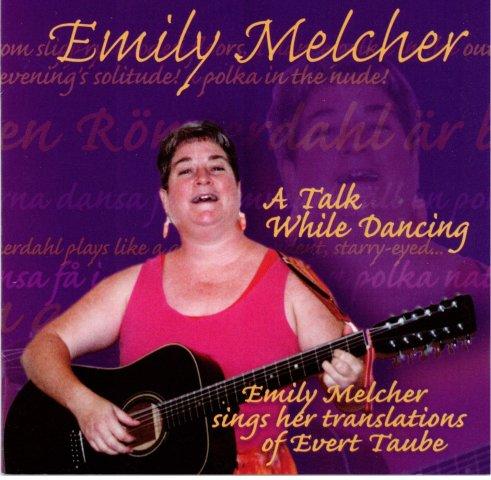
A
Talk While Dancing
A
collection of my translations of songs by Evert Taube
Available on CD and cassette
Due
to copyright restrictions, I am unable to post lyrics or sound
bytes. Complete lyrics to my translations are available in
the CD booklet only.
Background:
Evert
Taube (1890 - 1976) is arguably Sweden's most beloved troubadour.
He wrote approximately 200 songs, ranging from sailor songs
to ballads to unparalleled depictions of Sweden to lyrical love
poetry.
I
have studied, performed and translated Evert Taube's songs for
over 25 years. I first learned to know and love Taube's songs
when I was an exchange student in Sweden. I was 16 years old,
young and romantic, and Taube's cheerful, romantic songs, with
their dance melodies, flirtations, and beautiful depictions
of Swedish life and the Swedish countryside spoke to me. I still
find myself connecting to that young, romantic girl inside of
me when I sing them. I am delighted to present my translations
and interpretations of several of my favorite Taube songs in
this collection.
About
Evert Taube's Songs:
The
vast majority of Evert Taube's songs are ballads, or songs that
tell stories. While not directly autobiographical, many of
them are informed by Taube's own experiences as a sailor, an
Argentinean "gaucho," (cowboy), a European and also
quintessentially Swedish artist, poet, musician and troubadour,
a flirt and a family man. Taube traveled extensively, and spent
a good deal of time away from Sweden, and the whole world was
his palette. More
than any other Swedish troubadour, Taube brought the world to
Sweden. Still, it is for his unparalleled and idyllic depictions
of everyday Swedish life and the Swedish countryside that Evert
Taube is most dearly loved.
There
are two central characters in Taube's songs, characters who
have the same types of life experiences that Taube had. Very
generally speaking, they can be seen as Taube's alter-egos.
The earlier character, Fritiof Andersson, is a sailor, cowboy,
musician and artist, a ladies' man who loves a dance and flirtation.
The
later character, Rönnerdahl,
who first appears in the 1940's, is a more mature character
who still relishes a dance and a flirtation, but who also enjoys
the pleasures of home and family life. You'll encounter both
in the songs in this collection.
About
the Songs on This Recording:
"Samborombom"
is a conversation between the cocky Fritiof Andersson and a
young woman named Carmencita, carried out mostly as they dance
a tango. In this playful and light-hearted flirtation, Carmencita
rebuffs Fritiof's request for her hand in marriage, contrasting
Fritiof's musicality with the riches of another suitor who is
soon to appear at her door, and opting in favor of the wealthy
man.
"Pepita
Dances a Tamborito in Panama" (Pepita dansar) is the story
of an indigenous South American woman who has had an affair
with a white man, and therefore been forced to leave her village.
She ends up in a brothel in Panama, where she sings and dances
her native "tamborito." This song is unusual in Taube's
production and of particular interest to me because it is written
from a woman's point of view: It is Pepita's song to Fernando,
the lover who has betrayed her.
"The
Serenade in San Remo" (Serenaden i San Remo) is one of
Taube's earliest lyrical love songs, written in 1927. Taube
had met Astri Bergman, daughter of the sculptor to the crown
of Sweden, when they were both part of an colony of Scandinavian
artists living in France in the mid-20's. They fell in love
and became engaged. When Astri's father learned of the engagement,
he ordered her to break it off and return home at once. Astri
did as she was told, but remained a part of Evert Taube. He
expressed that sense of belonging and the power of music to
hold them together in this song: "Still, you are here,
in my dream, in my song," (dock, du är här, i
min dröm, i min sång). Eventually, Astri's father
relented, and she and Evert were married.
"The
Joyful Baker in San Remo" (Den glade bagar'n) is a comical
song about a baker who sings while he works. Singing and kneading
the bread dough build up his upper body, and ladies come to
the bakery to watch him work, listen to him sing, and buy his
bread. His lovely wife stands at the counter, selling the bread.
When the baker sneaks out to visit with the ladies who have
flocked to the bakery, his wife has her own way of cooling things
down again.
"Fritiof
in Arcadia" (Fritiof i Arkadien) is a playful and light-hearted
song in which Fritiof Andersson is enjoying a picnic in the
warmth of the Italian sun. He is naked, save a garland round
his hips. Three young naked women approach him and invite him
to dance. They run off laughing gaily when the garland falls
from his hips. Later he meets them in town, and walks and talks
with one of them, who turns out to be an American from San Francisco.
"Heav'n
Blessed Soil" (Himlajord) tells of a Swedish emigrant to
Australia, who has settled on a very fertile piece of property
where he raises citrus fruit and animals. There is a discussion
between this romantic farmer, who believes that the fertile
soil of his property has sprinkled down with blessings from
heaven, and his more pragmatic guest, who offers the scientific
explanation that the soil is actually loess, or desert soil,
borne on breezes to an area where there is sufficient precipitation
to make it extremely fertile. The farmer's romanticism continues
unabated until his fertile soil embraces his dead body, and
the limits of his wealth and extent of his debt are revealed.
Still, the pragmatic visitor has gained an appreciation for
the strength that the farmer's romantic faith brought him.
"The
Joyful Nudist" or "A Happy Little Polka" (Den
lycklige nudisten) is a polka, an old man's romp in the buff.
It playfully pokes fun at stuffy society dances while singing
the praises of "a polka in the nude" (en polka naturell).
"Rose
at the Ball" (Rosa på bal) is a favorite of Swedes,
who generally love a sing-along. This song consists entirely
of a flirtatious conversation between Rose and Fritiof Andersson,
and so it makes a wonderful sing-along, with the men singing
Fritiof Andersson's part, and the women singing Rose's.
In
"The Boarding-House Dance" (Dansen på Sunnanö),
you'll encounter Taube's 2nd alter-ego, Rönnerdahl, as
he dances with young Eva Liljebeck. They flirt as they dance,
but when things begin to get too heated up, Rönnerdahl
calls for his fiddle, and he plays the night away, while Eva
dances with someone else. (A typical feature of Taube's songs
is that the flirtation leads to artistic inspiration rather
than to romance). This song is ultimately about the transcendent
power of art; Taube depicts Rönnerdahl as he plays the
fiddle: "But Rönnerdahl plays like a god, transcendent,
starry-eyed" (Men Rönnerdahl är blek och skön,
och spelar som en gud).
"Sjösala
Waltz" (Sjösalavals) shows Rönnerdahl waltzing
outdoors one spring morning as the meadow is in bloom. Now an
older but still joyful and vital man, he greets the spring,
the squirrels, the cuckoo, and then waltzes back into the house,
waking his wife and children, who share his joy and delight
at the coming of spring. "Sjösala Waltz" is an
idyllic portrayal of country life and the pleasures of nature
and family.
"Calle
Schewens Waltz" (Calle Schewens vals) was, at the time
of Evert Taube's death in 1976, the most played song ever on
Swedish radio. There were many reasons for this, but the most
compelling is that this song resonated deeply with the Swedes
in several ways: It is an absolutely exquisite depiction of
a Swedish summer night; it contains elements from folk tradition;
and it musically embodies the shift from dusk to night to dawn
in a way that is unique in Taube's production. The action and
the character of Calle Schewen are also quintessentially Swedish.
The story takes place on an island in the archipelago off of
Sweden's east coast, where summer nights are only about 3 hours
long. In the song, Calle Schewen describes the approach of dusk
as he sits, peacefully drinking a cup of laced coffee. He hears
the strains of dance music, and is compelled to dance. Although
a grandfather, he is filled with the vim and vigor of the island,
and he dances through the night with a young woman, the "rose
of the isle" (roslagens ros). As darkness falls, the song
shifts into a minor key and Calle likens his dance partner to
an elf and himself to a troll. When dawn approaches, the song
shifts back into a major key, and ends with Calle's joyful proclamation:
"Here dances Calle Schewen with the rose of the isle! He
dances on into the day!" (Här dansar Calles Schewen
med roslagens ros. Han dansar när solen går opp!)
"Sleep
in My Arms" (Sov på min arm) is Taube's most exquisite
lyrical love poem. This erotic lullaby has been a favorite of
mine for 25 years, and I frequently close my concerts with it.
This recording contains both my translation and Taube's original
Swedish.